
Places of worship have a difficult balance to get right when it comes to security. Churches, mosques, gurdwaras, synagogues, temples and other faith buildings are there to welcome people, and many are used for far more than worship, with community groups, children’s activities, events, meetings, food programmes and volunteers coming and going throughout the week.
That openness is part of what makes these places important to their communities, so improving security shouldn’t simply mean locking everything down or making people feel unwelcome. The aim is to understand the risks around your particular site and community, put sensible measures in place, and make sure those measures are safe and manageable for the people who will actually be responsible for them.
You don’t need to be a facilities manager or security professional to start doing that. A useful place to begin is with five questions:
Before buying anything, look backwards.
Has your place of worship experienced vandalism, theft, threatening behaviour, hate crime, unauthorised parking or people entering areas they shouldn’t? Have members of your community raised concerns, or have there been incidents nearby that might be relevant to your site?
Even incidents that seemed relatively minor at the time can become useful when viewed together. A damaged fence one month, somebody entering the car park overnight another month and repeated antisocial behaviour around the same entrance may start to reveal a pattern that wasn’t obvious when each incident was treated separately.
It is also worth speaking to the community because the people who use the site at different times often notice different things. Someone opening a church early on Sunday morning may have a completely different experience from the person locking up after an evening community group, while volunteers arriving before Friday prayers at a mosque may notice problems around parking or vehicle access that aren’t obvious at quieter times.
Start keeping a simple record of what happens, including the date, time, location, what happened, photographs or CCTV where appropriate, whether it was reported and what action was taken.
It doesn’t need to become a complicated security database. A simple and consistent log is already much more useful than trying to remember everything six months later.
Not sure where to start?
You don’t need to know which security system you need. Tell us what’s been happening at your site and what you’re concerned about, and our team can help you understand what might be worth looking at.
Talk to us about your concerns →
Once you’ve looked at the past, walk around the site and look at how it works today.
Don’t just inspect the front door. Start outside the boundary and work your way towards the building, thinking about how somebody, or a vehicle, could reach the areas you’re trying to protect.
The perimeter
Look at fences, walls, hedges and the edges of your property. Could someone simply walk around the main gate, climb over a low boundary or use an area where fencing has become damaged?
Vehicle entrances
Can anybody currently drive onto the site? If you have private grounds or a car park, think about what prevents vehicles entering when the site is closed and how access is managed when it is busy.
Pedestrian entrances
Which entrances are normally open, who uses them and are there side gates or alternative routes that aren’t being properly controlled?
Buildings
Which doors should be publicly accessible and which should be restricted? Think about offices, storage areas, community halls and other buildings as well as the main place of worship.
Quieter areas
Walk around the back of buildings, between structures and alongside car parks. Areas that aren’t visible from the main building can easily be overlooked.
Then do the same walk after dark. Poor lighting, hidden corners and gaps in CCTV coverage can look completely different once the site is quiet.
Security at a place of worship isn’t static.
A church might be relatively quiet on Tuesday afternoon and then have hundreds of people arriving for a Sunday service or Christmas celebration. A mosque may experience concentrated vehicle and pedestrian movements around Friday prayers and much larger numbers during Eid. A synagogue’s activity changes around Shabbat and religious festivals, while gurdwaras and Hindu temples may have regular worship alongside community activities, celebrations and major festivals such as Vaisakhi or Diwali.
These occasions don’t automatically mean the site is less secure, but the way people use the site changes, and your security arrangements need to cope with that.
Ask yourself:
Security needs to work when 500 people are arriving as well as when nobody is there.
Only after understanding the risks and vulnerable areas should you start looking at security equipment.
You probably don’t need everything on this list, and the right combination will depend on your site.
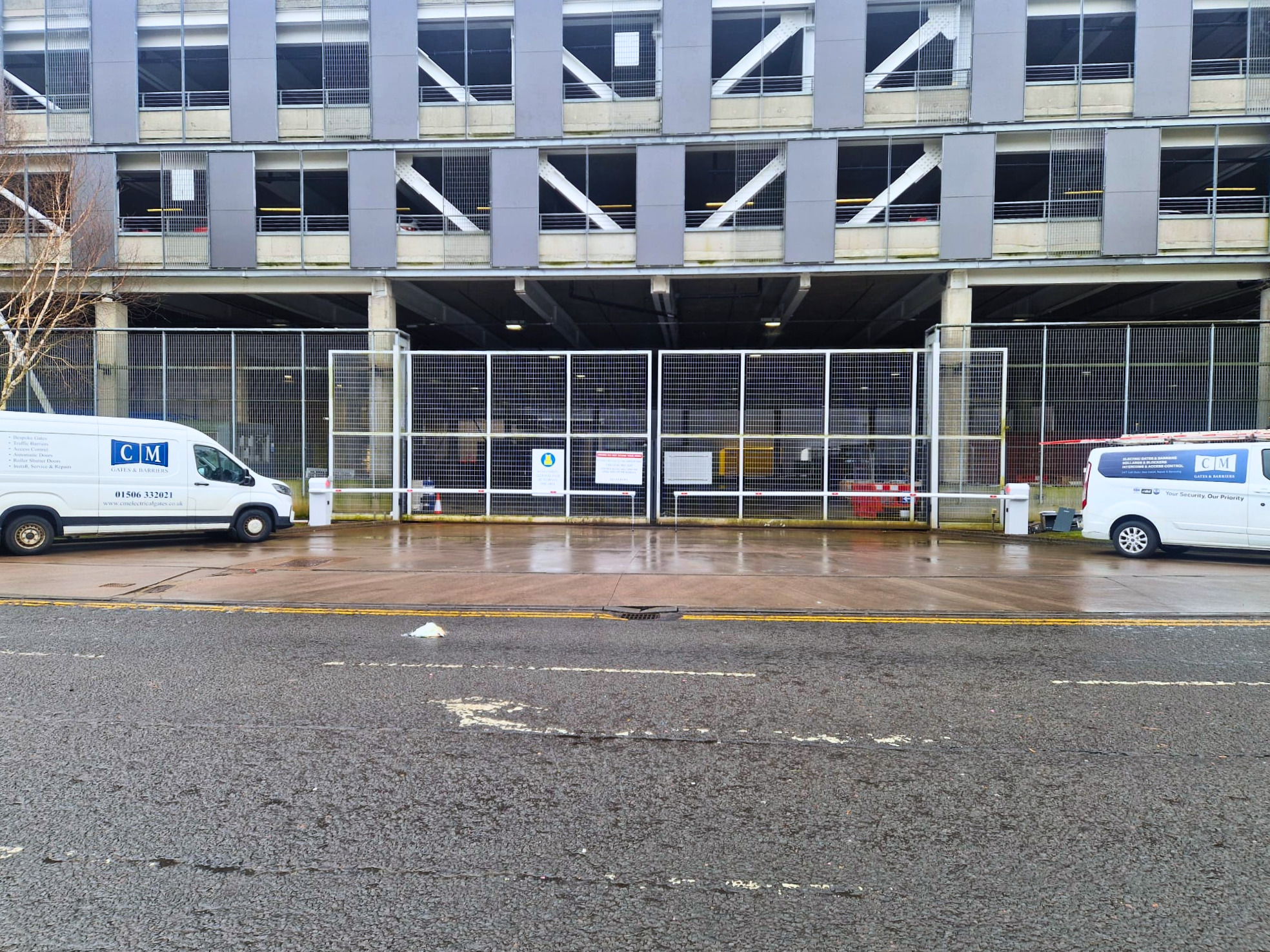
Electric gates can help control vehicle access to private grounds and car parks while still allowing authorised people to enter through an intercom, keypad, fob, mobile system or other access control.
For a church, mosque, synagogue, gurdwara or temple with its own grounds, this can create a much clearer point between public and controlled space.
Where you have a busy car park and vehicles need to enter and leave frequently, an automatic barrier may be more practical than completely closing the entrance with a gate.
A barrier controls vehicles, however, so don’t assume it also solves pedestrian or wider perimeter-security problems.
Vehicle security shouldn’t make pedestrian access difficult.
A dedicated pedestrian entrance can help separate people from moving vehicles, while access control can allow staff, volunteers or authorised community groups to enter without leaving the whole site open.
An intercom allows someone inside the site to speak to, or depending on the system see, a visitor before granting access. This can be particularly useful where the main vehicle or pedestrian entrance isn’t directly visible from the building.
Rather than simply asking “How many cameras do we need?”, think about what you actually need to see.
That could include people approaching an entrance, vehicles entering the car park, vulnerable areas around the perimeter or activity around the building when the site is closed.
Sometimes the main entrance isn’t the biggest vulnerability.
Repairing damaged fencing, improving a weak boundary or controlling an overlooked side entrance could make a bigger difference than adding another piece of technology.
Good lighting can improve visibility around entrances, pathways, car parks and quieter areas of the site, while also helping CCTV perform more effectively after dark.
Sometimes you don’t need another security system at all.
If you already have gates, barriers, access control or CCTV, getting the existing equipment properly inspected, repaired and maintained may be the most sensible first step.
We can help you look at your existing setup and recommend practical improvements based on how your church, mosque or place of worship actually operates, whether that’s improving what you already have or installing something new.
Explore our security solutions for places of worship →
A camera can help you see and record an incident, but it can’t physically stop someone entering. A gate can control a vehicle entrance, but it can’t tell you what’s happening behind the building, and fencing isn’t particularly useful if everybody leaves the side gate open.
For one church, the right solution might be an electric gate, intercom and improved lighting. A mosque with a busy car park might benefit from an automatic barrier, CCTV and separate pedestrian access, while another place of worship may simply need to repair its existing perimeter and introduce better access procedures.
Good security usually comes from several sensible measures supporting each other, rather than expecting one expensive product to solve every problem.
This is just as important as security.
Places of worship can have children running around, elderly visitors, people with disabilities, large crowds and pedestrians and vehicles arriving at the same time. During a busy Sunday service, Friday prayers, Eid, Christmas, Vaisakhi, Diwali or another major event, the way people move around the entrance can be very different from an ordinary weekday.
So if you’re considering electric gates or automatic barriers, don’t only ask whether they will keep unwanted vehicles out. Ask how your own community will move around them safely.
Think about:
Automated gates and barriers are machinery, so some aspects of their safety need to be assessed by competent professionals rather than trustees or volunteers trying to make technical judgements themselves.
And safety doesn’t stop on installation day. Components wear, equipment can be damaged and safety devices can develop faults, which is why regular inspection and maintenance matter. The purpose of security is to protect your community, so the security measures themselves also need to be safe.
Already have an electric gate or barrier?
If you’re unsure when it was last professionally inspected or whether it’s operating safely, we can assess and service existing automated gates and barriers, including systems originally installed by other companies.
Book a gate or barrier service →
Many places of worship don’t have a facilities manager, security manager or technically minded employee sitting in an office all week.
Security may instead fall to a minister, imam, rabbi, granthi, priest, trustee, administrator or volunteer who already has plenty of other responsibilities.
That’s completely normal, but it should influence the system you choose.
A sophisticated security system isn’t necessarily a good security system if nobody understands how to use it, nobody knows who maintains it and everybody panics when something stops working. Decide who is responsible for the basics and write it down:
You don’t need a 50-page security manual. Even a simple list of responsibilities and emergency contacts can prevent confusion when something actually happens.
No facilities team? That’s where ongoing support can help.
We provide planned maintenance, repairs and ongoing support for automated gates and barriers, so your volunteers or staff don’t need to diagnose technical problems themselves. They simply need to know who to call.
Talk to us about ongoing maintenance →
24/7 emergency call-out is available to contracted customers.
Imagine the electric gate won’t open shortly before Sunday service, or a barrier becomes stuck open overnight before Friday prayers. Perhaps somebody loses an access fob, CCTV stops recording, or there has been an incident and you suddenly need footage from a camera nobody has checked for months.
Who deals with it? Who knows how to make the equipment safe? Who contacts the engineer? Who calls the police or emergency services if necessary? And if the usual person is away, does somebody else know what to do?
This is where ongoing servicing and a clear relationship with whoever maintains your security equipment can be particularly valuable for places of worship without dedicated facilities teams. You don’t necessarily need somebody on site who understands how the machinery works, you just need somebody who knows who to call.
You don’t need to solve everything today.
Get two or three people who know the site well and spend half an hour walking around together. Ideally, include people who use the site at different times because they may notice completely different things.
Take photographs and make notes as you go.
Ask yourselves:
☐ What has happened here before?
☐ What are members of our community worried about?
☐ Are we keeping a record of incidents and recurring problems?
☐ Where could somebody enter our grounds or buildings?
☐ Can unauthorised vehicles enter the site?
☐ When is the site busiest and when is it most vulnerable?
☐ Are pedestrians and vehicles moving around safely?
☐ Are there areas we can’t see clearly, particularly after dark?
☐ What security equipment do we already have and does it work?
☐ When were our gates, barriers or other automated equipment last serviced?
☐ Who is responsible for security day to day?
☐ If something failed or an incident happened tonight, would we know what to do and who to call?
You don’t need perfect answers.
The purpose is to understand what has happened, what you already have, what worries your community and where you may need some help.
Don’t throw those notes away once you’ve finished walking around the site.
Keep a simple record of incidents, photographs, concerns raised by members of your community, previous police reports where relevant, maintenance records and improvements you’ve already made, and update it when something changes.
Over time, that gives you a much clearer picture of your site’s security needs and helps you prioritise where limited budgets should be spent.
It can also become valuable if you later seek funding to improve security at your place of worship.
Funding programmes have their own eligibility and evidence requirements, and keeping records doesn’t guarantee that an application will be successful. However, being able to clearly demonstrate what has happened, what risks you’ve identified, who may be affected, what you’ve already done and what still needs improving can help you explain why additional security measures are needed.
So even if there isn’t a relevant funding opportunity available to you today, doing this work now isn’t wasted.
You don’t need an engineer to tell you that a broken security light needs replacing or that an old access code should be changed.
But equally, trustees and volunteers shouldn’t be expected to make technical decisions about automated machinery, gate safety, complex access control or specialist protective security threats.
If you’re considering changes to electric gates, barriers, CCTV, access control or your perimeter, getting professional advice early can help you understand what is appropriate before committing money to equipment.
For more serious risks, particularly terrorism or concerns about vehicles deliberately being used to harm people, specialist protective security advice should be sought. An ordinary electric gate or traffic barrier should not be assumed to provide protection against a hostile vehicle simply because it creates a physical obstruction.
ProtectUK provides free protective-security guidance and resources, while NPSA provides specialist guidance for more complex protective-security risks.
If you’ve completed the review and still don’t know exactly what you need, that’s fine. You now have something much more useful than a shopping list.
You have your site’s history, your community’s concerns, the areas you’re worried about, the security measures you already have and the gaps you think need attention.
Bring that information together and use it to have a proper conversation about your site.
CM Gates & Barriers can help with the physical side of that picture, including electric gates and barriers for churches, mosques and other places of worship, CCTV, access control, pedestrian and vehicle entrances, perimeter security and ongoing maintenance, and help identify practical improvements that fit the way your site and community actually operate.
CM GATES & BARRIERS LTD is registered as a limited company in Scotland under company number SC591844
Registered Address: 4 Polbeth Industrial Estate, Polbeth, West Calder, Scotland, EH55 8TJ
We have many happy customers across Glasgow, Edinburgh, Aberdeen, Dundee, Paisley, East Kilbride, Livingston, Dunfermline, Hamilton, Cumbernauld, Kirkcaldy, Inverness, Perth, Kilmarnock, Ayr, Coatbridge, Greenock, Glenrothes, Stirling, Airdrie, Falkirk, Irvine, Dumfries, Motherwell, Rutherglen, Cambuslang, Wishaw, Bearsden, Newton Mearns, Clydebank, Elgin, Renfrew, Bishopbriggs, Bathgate, Arbroath, Kirkintilloch, Musselburgh, Dumbarton, Bellshill, Peterhead, St Andrews, Bonnyrigg, Barrhead, Blantyre, Penicuik, Grangemouth, Kilwinning, Broxburn, Johnstone, Larkhall or Erskine. Call us today for a free quote.
Terms of Use | Privacy & Cookie Policy | Trading Terms
© The content on this website is owned by us and our licensors. Do not copy any content (including images) without our consent.